Branches and headers
Copper components engineered for high efficiency and durability
Refrigera® branches and headers are fully designed and manufactured in Italy using carefully selected high-quality copper, ensuring maximum efficiency in VRF and multi-split systems. Each component is the result of a rigorous engineering process focused on dimensional accuracy, long-term tightness, and compatibility with the most widely used system architectures for variable refrigerant flow air conditioning.
Reliable and durable solutions, also available with customized insulation certified in Class 1.


Gas R717 (NATURAL REFRIGERANTS: AMMONIA)
Ecological profile:
Natural – 100% sustainable (GWP = 0)
Technical characteristics & installation challenges:
Ammonia (R717) is a natural refrigerant offering extraordinary thermodynamic efficiency for large-scale systems; however, it is toxic (Class B2L) and chemically incompatible with copper and copper alloys. This application requires the exclusive use of components made from steel, stainless steel, or specific aluminum alloys, featuring highly reliable welds and flanged joints.
The Refrigera design solution:
Within our manufacturing operations, we dedicate specific engineering efforts to steel and stainless steel components suitable for ammonia systems. We subject every part to rigorous quality control and functional testing to ensure maximum operational safety and prevent accidental leaks of the toxic fluid.
Typical applications:
Large-scale industrial refrigeration plants, major logistics cold storage warehouses, and freezing systems for the food industry.

Gas HFC VRF (FLUORINATED REFRIGERANTS: VRF SYSTEMS)
Ecological Profile:
Summary – High-Efficiency Air Conditioning Systems
Technical Characteristics & System Challenges:
VRF systems manage climate control for entire buildings by distributing refrigerant (typically R410A or the newer R32) to numerous indoor units via complex piping networks. The technical challenge lies in dynamically balancing flow rates, preventing pressure drops (which reduce overall system efficiency), and ensuring proper oil return to the compressors across extensive piping runs.
The Refrigera Design Solution:
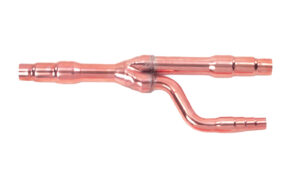
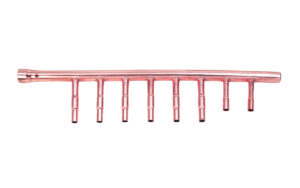
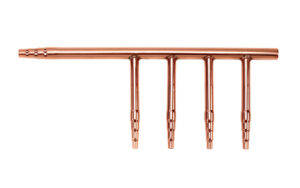
We are recognized specialists in the design of high-quality copper manifolds and branch joints (Y-joints). Each joint is engineered to ensure tight dimensional tolerances and smooth internal geometries that optimize gas distribution and prevent pressure drops; Class 1 certified insulation shells are also available.
Typical Applications:
Ducted and direct-expansion air conditioning systems for hotels, offices, shopping centers, and residential complexes.

Gas HC (Natural Refrigerants: Hydrocarbons)
Environmental profile:
Natural – 100% Sustainable (GWP < 3)
Technical characteristics & installation challenges:
Hydrocarbon refrigerants, such as Propane (R290) or Isobutane (R600a), offer excellent thermodynamic and heat-transfer properties but are highly flammable (safety class A3). They require components with absolute leak-tightness, compact geometries to reduce the total gas charge, and an intrinsically safe design to prevent any risk of ignition.
The Refrigera design solution:
We develop valves and fittings specifically for hydrocarbons, featuring reinforced mechanical connections and polymer seals that have been laboratory-tested to withstand the effects of flammable fluids. Our design focuses on reducing internal volume to minimize the gas charge within the display case or refrigerated cabinet.
Typical applications:
Plug-in refrigerated cabinets, commercial refrigerated display cases, compact water chillers, and latest-generation residential heat pumps.

Gas HFC / HFO (Fluorinated refrigerants)
Environmental profile:
Synthetic – Transition to Lower Impact (Low/Medium GWP)
Technical characteristics & system challenges:
The green transition necessitates a progressive phase-out of traditional high-GWP HFCs (such as R404A) in favor of HFO mixtures (such as R1234ze or R513A) or lower-impact blends (e.g., R32, R452A). These modern fluids often exhibit mild flammability (Class A2L) and require medium-to-high operating pressures (up to 45–60 bar), demanding components that are versatile, compatible, and high-performing across a wide temperature range.
The Refrigera design solution:
We offer a comprehensive range of shut-off, check, and safety valves optimized for safe operation with most new HFC and HFO gases. Materials and polymer seal compounds are tested in our laboratory to ensure chemical stability and resistance to cracking over time.
Typical applications:
Industrial air conditioners, office chillers, rooftop units, and road and marine transport refrigeration systems.

Gas R744 (NATURAL REFRIGERANTS: CARBON DIOXIDE)
Environmental profile:
Natural – 100% sustainable (GWP = 1)
Technical characteristics & system challenges:
In subcritical CO₂ (R744) cycles, condensation occurs below the critical point (31.1°C) at intermediate operating pressures (typically between 40 and 60 bar). This technology is widely used in cascade systems, where CO₂ operates on the low-temperature side and a second fluid handles the high-temperature side. It requires components with high thermal resistance and excellent fluid dynamics to optimize the overall COP.
The Refrigera design solution:
We supply shut-off and check valves designed to withstand continuous cycling and thermal fluctuations, ensuring perfect sealing at the fittings and joints of central units and medium-temperature storage modules.
Typical applications:
Low-temperature cold rooms, industrial blast freezing systems, refrigerated display cases, and cascade systems for large-scale retail.
Gas R744 (NATURAL REFRIGERANTS: CARBON DIOXIDE)
Environmental profile:
Natural – 100% sustainable (GWP = 1)
Technical characteristics & system challenges:
In the transcritical CO₂ (R744) cycle, the refrigerant operates above its critical temperature (31.1°C) without condensing in the gas cooler. This configuration entails extremely high operating pressures (often exceeding 100 bar, with design peaks up to 140 bar), placing significant stress on the structural integrity of valves, seals, and manifold welding systems.
The Refrigera design solution:
Our valves for transcritical R744 applications are the result of heavy-duty structural design and rigorous laboratory testing. We utilize reinforced brass bodies and connections made of copper-iron alloys (e.g., C194) or stainless steel, featuring polymer seals tested to withstand operating pressures of up to 140 bar and prevent fugitive emissions.
Typical applications:
Booster refrigeration systems for supermarkets, mobile air conditioning (road and rail transport), and high-temperature heat pumps.
You need
technical information?
